
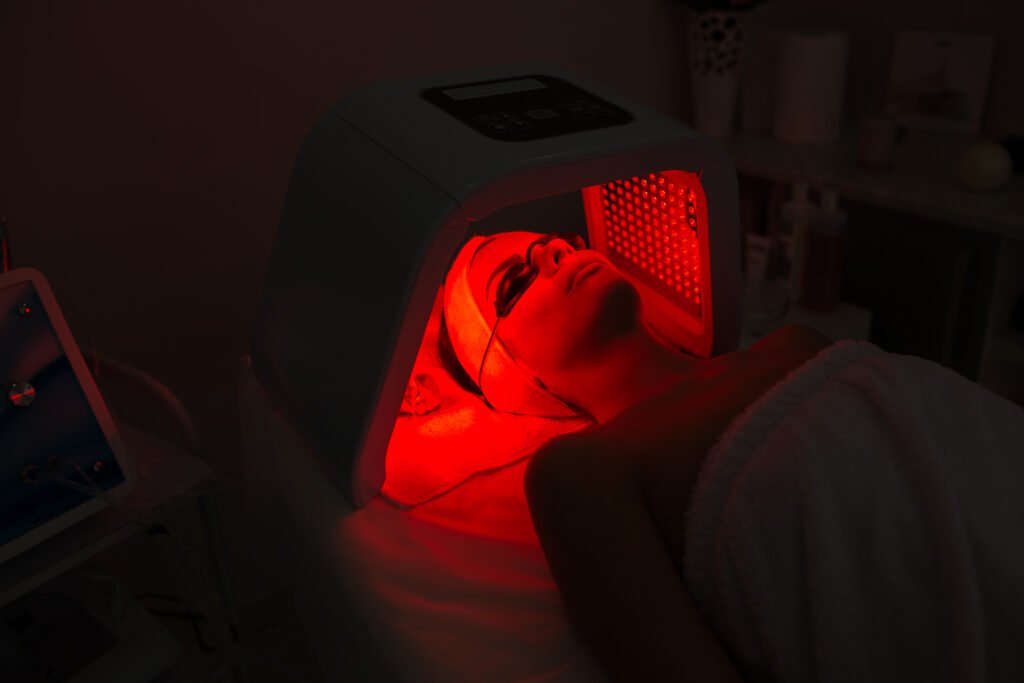
You’ve seen the glowing masks on TikTok. You’ve seen the “before and afters” that look a little too good. And now you’re wondering if red light therapy for acne is real science or just a very expensive night light.
Short answer: there’s real science behind it, there’s also a lot of hype, and the truth sits somewhere in the middle. Red light won’t make a breakout vanish overnight, and anyone promising that is selling you something. But for one very specific, very annoying type of pimple (the deep, sore, under-the-skin kind), red light is one of the more interesting tools you can use at home.
This guide breaks it down in plain English: what red light therapy is, what it does to your skin, what the research actually says, where it falls short, and how to use it without carving out 20 minutes a day to sit in front of a panel.
What is red light therapy?
Red light therapy is exactly what it sounds like: shining visible red light onto your skin. Not UV. Not heat. Not lasers burning anything off. Just low-energy light in the red part of the spectrum, usually somewhere between about 620 and 700 nanometres (nm).
In clinics and research papers you’ll also see it called low-level light therapy (LLLT) or photobiomodulation. Big words, simple idea: certain wavelengths of light are absorbed by your cells and nudge them to behave a little differently.
A review from researchers at Harvard’s Wellman Center for Photomedicine explains the basic mechanism: red and near-infrared photons are absorbed by structures inside the mitochondria (the energy factories in your cells), which can increase energy production (ATP), boost blood flow and switch on signalling pathways linked to repair and lower inflammation. The same review lists acne among the inflammatory skin conditions that light therapy may help manage, while noting more testing is needed.
That’s the “how”. Now the “so what”.
What does LED stand for in skincare?
LED stands for light-emitting diode. It’s the same tech in your phone screen and your fairy lights, just tuned to specific colours (wavelengths). When people say “LED skincare” or “LED light therapy”, they mean devices that use LEDs to deliver a set wavelength of light to the skin: red, blue, near-infrared, or a mix.
LEDs matter because they’re small, cool, low-power and cheap enough to fit into masks, wands and, yes, patches. That’s what moved light therapy out of the clinic and into your bathroom.
What is LED skincare, then?
LED skincare is the umbrella term for any skincare device that uses LED light. Different colours do different jobs:
- Blue light (around 415nm) mainly targets acne-causing bacteria near the surface.
- Red light (around 630-660nm) goes a bit deeper and is linked to calming inflammation and supporting the skin’s own repair process.
- Near-infrared goes deeper still and is mostly marketed for things like recovery and anti-ageing.
For acne, red and blue get the most attention. nyxe uses red light in the 630-650nm range, which is the band associated with reaching inflamed tissue below the surface.
Red light therapy for acne: what does it actually do?
Here’s what red light therapy does to a pimple, based on what nyxe says on its about page and what the wider research suggests.
Red light at 630-650nm penetrates the skin just deep enough to reach the oil glands and inflamed tissue under a pimple. Within roughly the first day of use, the aim is to:
- Calm inflammation. Red light is associated with stimulating cell repair and dialling down the inflammatory response. That’s the swelling, heat and tenderness you feel in a deep pimple.
- Support circulation. It promotes blood flow to the area, which helps your skin get on with healing itself.
- Do it without drying you out. Unlike harsh spot treatments, red light doesn’t strip or peel your skin. It works with your skin’s healing process instead of attacking the surface.
What people typically notice first is a drop in pain and swelling, especially on larger, under-the-skin pimples (the kind that show up on your jawline before your period or the week of a big deadline). A deep pimple won’t disappear in a day. But “less sore and less angry” is a real, noticeable win when you’ve got a lump that hurts every time you smile.
Red light therapy benefits for skin and face
So what is red light therapy good for? For your face specifically, the benefits people look for are:
- Less redness and swelling on inflamed pimples
- Less tenderness, especially on deep, painful bumps
- Gentle on skin: no peeling, stinging or dryness from the light itself
- Supports healing, so the pimple moves through its cycle without you making it worse
You’ll also see red light marketed for wrinkles, scars, hair growth, sleep and more. Some of that has early research behind it, some of it is wishful thinking. This guide is about acne, and we’re keeping it that way. (For a deeper look at the overhyped stuff, see our breakdown: Is red light therapy legit or a hoax?)
What the research says (honestly)
Time for the part most brands skip.
There are encouraging studies. In a split-face randomised trial published in Dermatologic Surgery, 28 people with mild to moderate acne used a portable red light device on one side of the face for 15 minutes twice a day for eight weeks. The treated side showed a significantly bigger improvement in both inflamed and non-inflamed spots compared with the untreated side. The authors concluded red light alone could be a new option for acne.
An earlier randomised study in the British Journal of Dermatology tested blue light, combined blue and red light (415nm and 660nm), white light and 5% benzoyl peroxide in 107 people with mild to moderate acne. After 12 weeks, the combined blue-red group saw a mean 76% improvement in inflamed lesions, and the researchers suggested red light’s anti-inflammatory action was part of why the combination did well.
Now the reality check. A Cochrane review, which pooled 71 studies with 4,211 participants, concluded that high-quality evidence on light therapies for acne is still lacking. Most studies were small, used wildly different wavelengths and schedules, and many were industry-funded. The reviewers couldn’t draw firm conclusions about how light therapy stacks up against other treatments.
The American Academy of Dermatology lands in a similar place: visible light (blue, red, or both) can help with pimples, but it doesn’t treat blackheads, whiteheads, cysts or nodules on its own, results vary from person to person, and light therapy usually works best as part of a broader plan.
So here’s the honest summary:
- Studies suggest red light can help calm inflamed pimples.
- It’s not a magic switch. Results vary and the evidence base is still growing.
- Consistency matters. Every study that showed results used light repeatedly over time, not once.
- It’s one tool, not the whole toolbox.
That’s exactly why nyxe treats red light as one half of a routine rather than the whole thing.
What red light therapy doesn’t do
Let’s be clear about the limits, because knowing them saves you money and frustration.
It won’t clear acne overnight. You might feel a difference in pain and swelling within the first day, but a deep pimple still needs time to work through its cycle. As nyxe’s own guide puts it: progress builds over days, not minutes.
It’s not for blackheads and whiteheads. Clogged pores are a different problem. Red light is aimed at inflammation, not at unclogging pores.
It doesn’t replace a doctor for severe acne. If you have lots of deep, painful nodules or cysts, acne that’s scarring, or breakouts that aren’t responding to anything, see a GP or dermatologist. Singapore’s HealthHub advises seeing a doctor if you have nodules, cysts or scars, or if acne isn’t improving after four to six weeks of pharmacy products. There are prescription options that a light patch simply can’t match.
It doesn’t fix the root causes. Hormones, stress, sleep and genetics still do what they do. Red light helps you manage the flare-ups; it doesn’t rewrite your biology.
It won’t erase old scars. Red light is about active, inflamed pimples. If your concern is existing scars or marks, that’s a different conversation.
Why deep pimples need a different approach
Not all pimples are the same, and this is where most people go wrong.
Surface pimples (whiteheads, pustules with a visible head) sit near the top of the skin. They’re full of fluid you can see. A hydrocolloid pimple patch is great here: it absorbs the gunk, flattens the bump and keeps your fingers off.
Deep pimples (the sore, swollen bumps with no head, often called blind pimples, or the bigger hormonal and cystic-type breakouts) live under the surface. There’s nothing for a sticker to absorb because the inflammation is below where the sticker sits.
That’s the gap red light is designed to fill. It reaches the inflamed tissue underneath, where a regular patch can’t. If you deal with jawline breakouts that cycle every month, read our guide to hormonal and cystic acne treatment, which covers when at-home care makes sense and when it’s time for a dermatologist.
Masks, wands, panels or patches?
Most red light products fall into four camps:
| Device | How you use it | Good for | The catch |
|---|---|---|---|
| LED mask | Strap it on your face for a set session | Whole-face coverage | You have to sit still, and it often ends up in a drawer |
| Handheld wand | Hold it over the spot | Targeting small areas | Your arm gets tired; easy to skip |
| Panel | Sit in front of it | Face and body | Bulky, pricey, not travel-friendly |
| Wearable patch | Stick it on the pimple and go | One stubborn pimple at a time | Targets single spots, not your whole face |
Here’s the thing about every study above: the results came from people using light consistently. A device only works if you use it. And a mask that needs 20 quiet minutes twice a day is a hard sell when you’re juggling work, school, CCA, gym, or a 7am MRT ride.
A wearable patch flips the effort. You stick it on and get on with your day. You can wear it under a face mask, while you work, or overnight. No sessions to schedule. For a side-by-side look at costs, convenience and coverage, see red light therapy devices compared.
How the nyxe red light patch works
The nyxe box is a monthly acne care system built around two kinds of patches. The headline act is the red light patch: a small, wearable, semi-reusable electronic patch that delivers 630-650nm red light right where you need it.
Each nyxe box includes:
- 4 semi-reusable red light therapy patches
- Hydrocolloid sticker patches for daily surface breakouts
- Alcohol swabs to clean your red light patch
- Replacement adhesive stickers
- A quickstart guide
Here’s the usage straight from the nyxe guide:
- Clean and dry the skin.
- Pull the tab to activate the red light.
- Peel off the backing and stick the patch on the pimple.
- Wear it for 24-48 hours, with a minimum of 5 hours per use. You can reinsert the pull tab and store the patch between uses.
- Clean it with an alcohol swab after each use, and swap in a fresh adhesive sticker when it stops sticking.
Each red light patch is good for up to about 30 hours of total wear. The guide recommends about one patch a week for deeper pimples, which is why there are four in a box: one for each week of the month.
For timing tips, where to wear it, and how to fit it into a busy day, read how to use red light therapy at home.
The two-patch logic
Red light handles the deep, inflamed one. Hydrocolloid stickers handle the surface ones. Together, they cover both kinds of breakout without a 12-step routine.
The nyxe 30-day routine looks like this:
- Week 1: Calm active breakouts. One red light patch on your most inflamed pimple, sticker patches daily on surface spots. Typical experience: less redness and swelling on deep pimples.
- Week 2: Support healing. Keep up the stickers; use another red light patch if a new deep one appears. Typical experience: fewer new pimples, calmer skin.
- Week 3: Stay consistent. Third red light patch if needed, daily stickers for minor flare-ups. Typical experience: breakouts that feel smaller and less painful.
- Week 4: Defend and prevent. Last red light patch only if necessary; stickers as a preventive step.
These are typical experiences, not promises. Everyone’s skin is different. But the pattern is the point: early, consistent, low-effort care.
Tips to get the most out of red light
- Go early. Don’t wait for the pimple to peak. Stick the red light patch on at the first sign of a deep, sore bump.
- Keep the area clean and product-free. Don’t put other acne products directly under the patch.
- Give it time on the skin. At least 5 hours per wear; 24-48 hours is the sweet spot.
- Keep it clean. Alcohol swab after every use to avoid build-up.
- Don’t pick. Picking pushes inflammation deeper and raises the risk of marks and scars. The AAD notes that picking and popping make acne take longer to clear and increase the risk of scarring and dark spots.
- Know when to escalate. If deep, painful bumps are frequent, widespread or scarring, see a doctor.
Is red light therapy safe?
For most people, at-home red light is considered low risk. It’s visible light, not UV, and it doesn’t heat or burn the skin at the levels used in consumer devices. In the Cochrane review, blistering was reported only in studies of other light types (intense pulsed light, infrared and photodynamic therapy), not plain red LED light.
That said:
- Check with your doctor first if you’re pregnant, taking medication that makes you sensitive to light, or have a light-sensitive condition.
- Stop and get advice if your skin reacts to the adhesive.
- Don’t use red light as a substitute for medical treatment of severe acne.
FAQ
What is red light therapy, in one sentence?
It’s a non-invasive treatment that uses low-energy visible red light (nyxe uses 630-650nm) to help calm inflammation and support your skin’s natural healing.
Does red light therapy for acne actually work?
Studies suggest red light can help reduce inflamed pimples, especially when used consistently, but the overall evidence is still limited and results vary. It works best as one part of a routine, aimed at deep, inflamed pimples rather than blackheads or whiteheads.
What does red light therapy do to a pimple?
It reaches the inflamed tissue under the surface, where it’s associated with calming the inflammatory response and supporting blood flow. People typically notice less swelling and tenderness first.
What are the benefits of red light therapy for your face?
For acne-prone faces, the main benefits are less redness, less swelling and less pain on inflamed pimples, without the dryness or peeling that harsh spot treatments can cause.
What is red light therapy good for besides acne?
It’s marketed for lots of things, from wrinkles to hair growth. Some uses have early research, many are overhyped. If you’re buying it for acne, judge it on acne.
What’s the difference between red and blue LED light for acne?
Blue light (around 415nm) mainly targets acne bacteria near the surface. Red light (around 630-660nm) goes deeper and is linked to calming inflammation. Some devices combine both.
How long does it take to see results?
Many people notice less pain and swelling on a deep pimple within the first day, but the pimple still needs days to resolve. Real progress builds over weeks of consistent use.
Can I use red light therapy with other acne treatments?
Yes, but don’t layer actives directly under the patch. Use your cleanser, moisturiser and SPF as normal, and keep the patch spot clean and product-free.
Should I see a doctor instead?
If you have severe, widespread, nodular or cystic acne, acne that scars, or you’re pregnant or on medication, see a GP or dermatologist. Red light is for the day-to-day flare-ups, not a replacement for medical care.
The bottom line
Red light therapy for acne isn’t magic and it isn’t a scam. It’s a gentle, low-effort tool that studies suggest can help calm the deep, inflamed pimples that regular pimple patches can’t touch, as long as you use it early and consistently.
The best device is the one you’ll actually use. That’s why nyxe made it a patch: stick it on the deep one, go about your day, and let the light do its thing. Want to know who’s behind it? Read our story.
Try red light on your next deep pimple: get the nyxe box (4 wearable red light patches + hydrocolloid stickers, delivered monthly, free shipping in Singapore and Malaysia).
Sources
- Avci P et al. Low-level laser (light) therapy (LLLT) in skin: stimulating, healing, restoring. Semin Cutan Med Surg, 2013. PubMed
- Na JI, Suh DH. Red light phototherapy alone is effective for acne vulgaris: randomized, single-blinded clinical trial. Dermatol Surg, 2007. PubMed
- Papageorgiou P et al. Phototherapy with blue (415 nm) and red (660 nm) light in the treatment of acne vulgaris. Br J Dermatol, 2000. PubMed
- Barbaric J et al. Light therapies for acne. Cochrane, 2016. Cochrane summary
- American Academy of Dermatology. Lasers and lights: How well do they treat acne?
- American Academy of Dermatology. Acne: Tips for managing
- HealthHub Singapore. Acne